Call us at 015453841648 for make an order.

The Digital Paradox: Why Shoppers Still Abandon Their Carts in the Age of E-Commerce

The landscape of global retail has been fundamentally transformed by the rise of e-commerce. With the sector generating over three trillion US dollars in revenue annually, one might assume that the convenience of online shopping has made it the universal default for consumers worldwide.
However, beneath the surface of this booming industry lies a complex and often contradictory relationship between consumers and digital storefronts. Despite years of technological advancement and the exponential growth of platforms like Amazon, Alibaba, and numerous direct-to-consumer brands, a significant portion of the population remains hesitant, frustrated, or outright unwilling to fully rely on online shopping. The reasons for this reluctance extend far beyond simple technological illiteracy, touching on deep-seated psychological needs for trust, the physical limitations of sensory experience, and a growing impatience with poor digital customer experience.
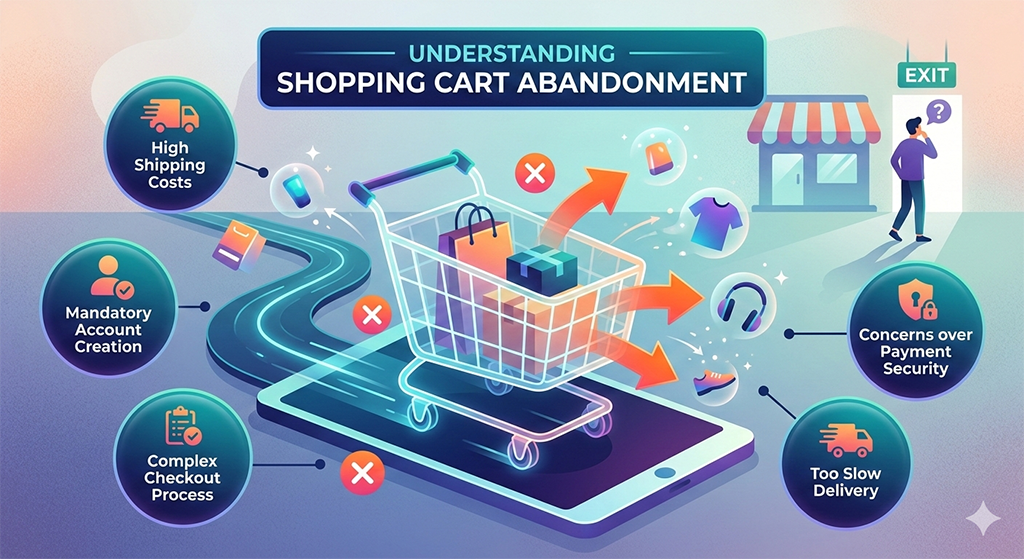
To understand why people do not fully rely on online shopping, one must first confront a staggering statistic: the average online shopping cart abandonment rate currently sits at nearly 70%, meaning that roughly two out of every three potential sales are lost at the final stage of transaction. This is not merely a reflection of “window shopping.” Rather, it is the culmination of friction points that begin at product discovery and end at the checkout page. According to the VML Future Shopper 2025 report, 45% of global shoppers regularly abandon their online purchases because the digital experience is too frustrating.
| Total cost is not visible upfront | Percentage of Respondents |
| Extra costs too high (shipping, tax, fees) | $48\%$ |
| Mandatory account creation | $26\%$ |
| Lack of trust (payment security) | $25\%$ |
| Delivery was too slow | $23\%$ |
| Too long / complicated checkout process | $22\%$ |
| Total cost not visible upfront | $21\%$ |
| Unsatisfactory returns policy | $18\%$ |
| Website errors or crashes | $17\%$ |
| Not enough payment methods | $13\%$ |
| Credit card was declined | $9\%$ |
This friction manifests in numerous ways. On the functional level, consumers report that basic online functions like search remain difficult to use, with 52% of users noting that standard features—such as a website remembering their preferences—are often missing. When a customer is forced to re-enter information or navigate a clunky interface, the cognitive load increases, transforming a task that should be effortless into a chore. This is particularly acute on mobile devices, where, despite the fact that 42% of all online sales are now transacted via mobile, the smaller screen real estate often exacerbates design flaws.
Chart: Leading Reasons for Shopping Cart Abandonment Worldwide (2024)
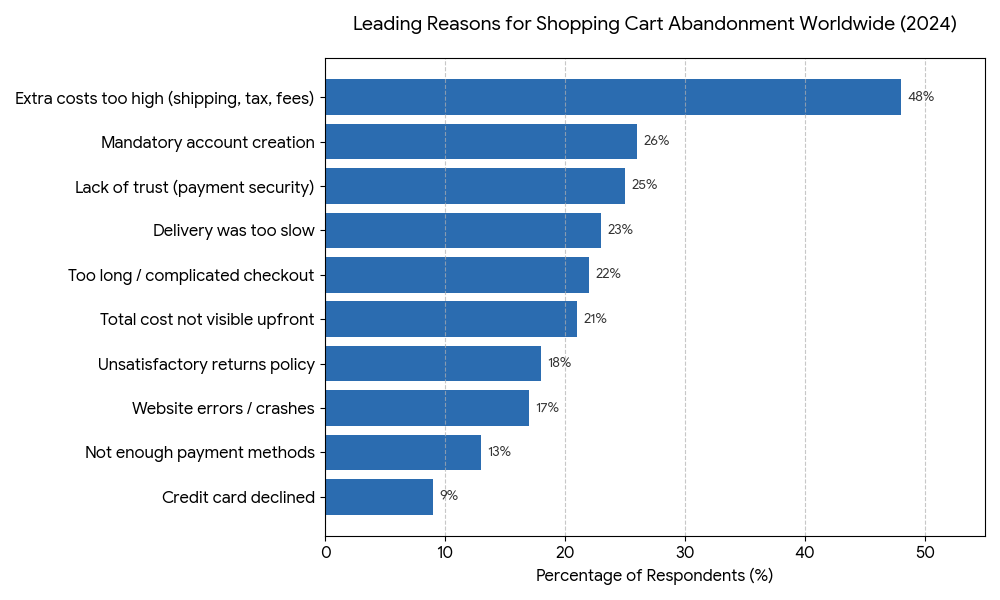
As the chart illustrates, the number one reason for abandonment—cited by nearly half of the US shoppers—is the shock of extra costs and fees at checkout. The “sticker price” advertised on a product page often excludes shipping costs, handling fees, or taxes, leading to a psychological phenomenon known as “price decoy.” When the final price exceeds the mental anchor set by the shopper, trust is broken, and the cart is abandoned. Furthermore, delivery logistics themselves are a major sticking point. In an age of instant gratification, 32% of shoppers now expect delivery within two hours, and 40% will not order from a store that cannot guarantee next-day or scheduled delivery. The mismatch between consumer expectations of speed and the reality of logistics creates a reliability gap.
Beyond the logistical hurdles, the most profound barrier to e-commerce reliance is the intangibility of the product. In a physical store, a consumer can touch a fabric, test the weight of an electronic device, or see if the color of a piece of furniture matches their living room. Online, this sensory information is replaced by pixels. This limitation forces consumers to rely on extrinsic cues—namely, product photos and reviews. However, recent research highlights a growing “trust paradox” in how consumers use these cues. A 2025 study published in the International Journal of Internet Marketing and Advertising found that while shoppers initially attribute trust to the quality of electronic Word of Mouth (eWOM) and product visualizations, this trust is frequently eroded.
The erosion occurs when consumers encounter fake reviews and ratings, incomplete information, or platforms they deem untrustworthy. Consequently, for high-priced items like electronic gadgets, consumers often transition back to offline Word of Mouth (WOM) to confirm, verify, and build confidence in their decision. This behavior underscores a fundamental lack of reliance on the digital ecosystem alone; the online world serves as a research tool, but the final “trust” required to purchase often still requires a human, offline element.
This skepticism is validated by academic research into how platforms engineer trust. A comprehensive 2026 review in Trust as Behavioral Architecture argues that trust in e-commerce has evolved from a personal sentiment into a “synthetic” condition engineered by platforms. Cues such as star ratings, fulfillment badges, and platform reputation are designed to systematically displace critical evaluation. While these heuristics are intended to reduce consumer anxiety, they also create vulnerabilities. The phenomenon of “trust inflation” suggests that the proliferation of high ratings and trust labels has made it harder for consumers to discern true product quality. Low-quality sellers can engage in “reputational arbitrage,” riding on the coattails of a platform’s overall trustworthiness to sell subpar goods. When consumers receive a product that does not match the reputation signaled by the platform, the betrayal felt is not just toward the seller, but toward the platform itself, further diminishing reliance on the channel.
The issue of trust is compounded by concerns regarding product safety and authenticity. Government research from the UK’s Office for Product Safety and Standards (OPSS) actively investigates consumer behavior on online marketplaces, highlighting a regulatory concern that products purchased online may not meet the same safety standards as those bought in traditional retail environments. The fear of receiving counterfeit goods, or worse, unsafe electronics or children’s toys, is a powerful deterrent. This is particularly true for demographics less accustomed to navigating the nuances of third-party sellers on platforms like Amazon or Marketplace, where the distinction between a reputable brand and a fly-by-night operation can be blurred.
Even for services, where no physical product changes hands, the preference for human interaction remains sticky. The Eden McCallum Consumer Sentiment Survey from Q3 2025 reveals a fascinating dichotomy: while 80% of UK and Dutch consumers use online channels to book travel or financial services, they still overwhelmingly prefer to use the phone when it comes to customer service for those services. As Dena McCallum, co-founder of Eden McCallum, notes, “For businesses trying to reduce their contact centre costs, this is a challenge… when things go wrong, people still like talking to a human” . The online channel is trusted for the transaction, but not for the resolution of problems. This suggests that reliance on e-commerce is conditional; it exists only as long as the process is flawless. The moment complexity or conflict arises, the digital medium is abandoned in favor of analog reassurance.
Table: Factors Influencing Consumer Choice of Online Retailers (UK, 2025)
This table breaks down the primary drivers for choosing an online retailer for non-grocery items, highlighting that value and quality are prioritized over brand familiarity or loyalty programs.
| Rank | Factor Influencing Retailer Choice | Percentage of Respondents |
| 1 | Value for Money | 48% |
| 2 | Good Quality Products | 42% |
| 3 | Ease of Home Delivery | 43%* |
| 4 | Cheaper Prices | 39%* |
| 5 | Better Product Choice | 32%* |
| Note: Percentages marked with an asterisk represent the top reasons to shop online generally, which overlap with factors for choosing a specific retailer. |
The data in the table reinforces the idea that the online shopper is a “rational actor” focused on utility. However, when the promise of “Good Quality Products” (42%) is broken by the reality of “trust inflation” and fake reviews, the entire value proposition collapses. The shopper feels they have failed to achieve value for money because the information asymmetry was too great.
Moreover, the very architecture of the internet is changing how consumers find products, which in turn affects trust. With the rise of generative AI and “agentic” shopping, 48% of consumers are interested in using AI agents to search for products at their preferred price points. While this may streamline discovery, it also creates a new layer of disintermediation. If an AI agent recommends a product and it fails, the consumer may not blame the obscure brand, but the AI that recommended it, creating a new vector for eroded trust in the digital ecosystem.
In conclusion, the reluctance to fully rely on online shopping is not a sign of Luddism, but a rational response to the inherent limitations and current failures of the digital medium. The initial promise of e-commerce—unlimited choice and convenience—has been tempered by the realities of logistical friction, the psychological discomfort of intangibility, and the systemic manipulation of trust signals. As the data shows, consumers are willing and eager to use digital channels for research and routine purchases, but their loyalty is conditional. They abandon carts at the sight of hidden fees, they revert to phone calls when service fails, and they seek offline confirmation when the stakes are high. For e-commerce to achieve the level of reliability that physical retail has enjoyed for centuries, the industry must move beyond simply digitizing the transaction and start rebuilding the sensory and trustworthy elements of the human shopping experience. Until then, the digital shopping cart will remain a place of intention, but not always of action.
References:
- Liu, K. J., Chen, S. L., Huang, H. C., & Gan, M. L. (2025). The trust paradox: An exploration of consumer psychology and behavior in cross-border shopping using E-commerce mobile applications. Acta Psychologica, 104778.
- Statista. (2025). E-commerce customer satisfaction – statistics & facts.
- African Marketing Confederation. (2025). Many brands still failing to deliver a good online customer experience.
- Eden McCallum. (2025). Eden McCallum Consumer Sentiment Survey Q3 2025 – Digital purchasing behaviours.
- Inderscience Publishers. (2025). eWOM – consumers’ tryst with trust and transitions – a qualitative study. International Journal of Internet Marketing and Advertising.
- Statista. (2025). E-commerce checkout behavior – statistics & facts.
- Marketing-Interactive. (2026). The Master Report: Are you closing the deal online?.
- Gov.uk. (2025). OPSS research into consumer behaviour on online marketplaces.
- MDPI. (2026). Trust as Behavioral Architecture: How E-Commerce Platforms Shape Consumer Judgment and Agency. Administrative Sciences, 4(1), 2.
- Campaign Asia. (2025). Nearly 1 in 2 shoppers drop purchases over poor online experiences, study finds.